Authentic aventurine is quartz containing naturally embedded mica flakes (typically fuchsite or hematite) that create its signature shimmer, showing variable color distribution in green, blue, or reddish-brown with a Mohs hardness of 6.5-7 and irregular inclusion patterns that shift under light.
Picture this: You're browsing an online marketplace or admiring a friend's jewelry when a sparkling green stone catches your eye. "Genuine aventurine," claims the description. But amidst glowing reviews and artful product photos, uncertainty creeps in. How can you verify what you're seeing? The challenge intensifies when comparing prices that range from suspiciously low to eye-wateringly high, each listing promising authenticity. Alongside that core question come others - about its light behavior, geological origins, or why two "aventurine" pieces look completely different. This guide will walk through those practical verification steps that can make all the difference without requiring a geology degree.
1. What defines aventurine's mineral composition and natural variations?
2. How does genuine aventurine interact with light?
3. What common misconceptions exist about this material?
4. What practical tests work for verifying authenticity?
5. How do color and inclusions indicate natural formation?
6. What differences help distinguish natural stones from synthetics?
Authentic aventurine comes from quartz deposits containing specific mineral inclusions like fuchsite (green), hematite (red-brown), or other shimmer-inducing particles, with distinctive hardness and origin patterns that set it apart from substitutes.
The foundational identity lies in its quartz base (SiO2) with naturally occurring mineral suspensions. While imitation materials might mimic appearance, they lack quartz's specific gravity (around 2.65 g/cm³) and thermal properties. Its Mohs hardness between 6.5-7 means it will scratch glass but typically not pure quartz test points. Unlike manufactured lookalikes, naturally-occurring deposits will differ regionally - Indian sources produce classic green varieties with fuchsite flecks while Russian deposits lean toward blue tones with ilmenite. These geological fingerprints are useful indicators when provenance is verifiable, as synthetics often lack locality-specific inclusion blends. Stone density comparisons can be especially telling since glass and resin alternatives tend to feel substantially lighter when weighed against similarly-sized quartz specimens.
Natural aventurine displays a phenomenon called aventurescence - a soft glittering effect where embedded mineral flakes selectively reflect light at narrow angles, differing significantly from manufactured versions.
Here's where genuine stones reveal their uniqueness: Rotate them slowly under a single light source and you'll notice the glitter sparks appear and disappear depending on the viewing angle. This flickering happens because the embedded mica platelets align irregularly rather than uniformly. Glass substitutes laced with copper flecks tend to maintain constant brightness when rotated due to manufactured flake consistency. If you're checking without special tools, compare outdoor natural light to indoor lighting– natural aventurine often looks subdued indoors but activates its sparkle dramatically in sunlight. That said, remember that quality natural stones may have uneven sparkle distribution. Don't expect perfect uniformity across the surface since geological formation is inherently less controlled than industrial production. Cloudiness between flecks can also be completely natural rather than a flaw indicator.
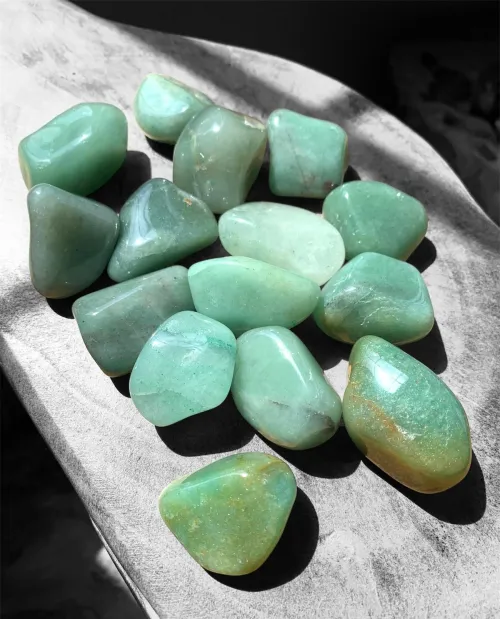
Several persistent myths require clarification: "always bright sparkles" guarantee quality, specific colors denote authenticity, or that weight/price can reliably differentiate real from imitation stones without practical examination.
The notion that genuine aventurine must have intense sparkles leads to expensive mistakes when shopping. Natural specimens often have understated glitter compared to copper-flecked glass counterfeits engineered for optical impact. Nor is color a foolproof indicator - synthetics successfully replicate greens and blues common in natural stones. Even experienced buyers sometimes assume that heavier pieces guarantee quartz content, but resin-stabilized imitations can be weighted artificially. Misleading marketing also misrepresents sunstone as "golden aventurine" despite differing mineral compositions. And counterintuitively, an "imperfect" surface with minor flaws tends to suggest natural material while factory-perfect polish often signals imitation products that lack internal variations authentic geology produces. If evaluating online, always request multiple videos showing the piece rotating slowly at different light angles instead of relying on glamour shots or gem terminology alone.
Verification happens through multisensory checks: observing how light plays across inclusions, detecting temperature response variations, checking surface friction, and magnification inspection for mineral patterns.
With basic tools, anyone can gather authenticating evidence before purchase. Start with the senses: Temperature tests prove quartz has higher thermal inertia than glass or plastic. Genuine aventurine remains cool against your cheek for roughly 10 seconds when room-temperature, while glass warms almost immediately. Next move to light behavior with simple desk lamp tests, watching carefully how flecks disappear or change intensity across 90 degrees of rotation. Magnification remains your most valuable assistant here – a 10x loupe reveals whether inclusions show natural mineral clusters or artificial bubble/cavity structures in synthetics. Below I've summarized key tactile and optical checks:
Geological authenticity reflects in the stone's "fingerprints": irregular mineral distribution, slight color zoning within specimens, subtle inclusions where fractures occurred, and fleck sizes that aren't engineered for consistency.
Natural formation creates variations that factory production struggles to replicate convincingly. Under magnification, authentic stones show clustered mineral flecks with incidental geological "debris" rather than mathematically placed particles synthetics can display. Color saturation tends to follow fracture lines in dyed materials - genuine aventurine won't show pigment concentrated around surface cracks. When presented with uniformly bright flecks across an entire specimen, consider the possibility of imitation glass. Blues or greens appearing unnaturally vivid throughout the entire depth can also be warning signs. Note that cut orientation matters: Translucency tends to decrease when slabs are cut perpendicular to mineral grain alignment. Ultimately, remember nature prefers asymmetry - consistently even fleck spacing is rare in earth-mined specimens.
Three synthetic categories prevail: aventurine glass with copper particles, dyed quartz misrepresented as natural, and resin composites - each with identifiable quirks across visual, tactile, and optical dimensions.
Copper-flecked versions are particularly widespread. Under magnification they reveal telltale signs: uniformly sized particles, bubbles trapped around flakes, overly geometric distribution patterns, and sharper facet edges from press-molding. Dyed quartz shows concentrated pigment near surface fractures when backlit with a penlight. Resin-based options, while less common, prove themselves through warmth response (rapidly matches body temperature) and unusually light weight. Crucially, synthetic materials typically over-perform indoors – their sparkle intensity remains constant despite lower ambient light, while genuine aventurine's shimmer behaves contextually. Thermal conductivity tests are especially revealing since glass alternatives warm 3-4 times faster than quartz. Professional-grade verification tools can detect deeper differences in refractive index or spectral signatures, but practical methods with household items can already offer high-confidence assessments.
When evaluating potential aventurine pieces, prioritize hands-on interaction: Request rotation videos showing different lighting angles, perform basic thermal response tests first, and document unique inclusion clusters when possible.
The most crucial takeaway? Trust variability. Real geology shows shifting sparkle angles, inconsistent fleck distribution, cool solidity when first touched, and subtle color fluctuations that imitations flatten out. Always engage multiple senses rather than relying on brilliance or color saturation alone. Ask sellers pointed questions about their authentication photos - natural light settings provide more information than studio lighting ever could. Remember that tools like pocket loupes or simple UV lights require minimal investment yet significantly boost detection accuracy. At some point you'll need to decide based on available clues, but with these methods, that decision leans on observable evidence rather than blind trust in marketing claims. The ideal purchase aligns your specific needs (jewelry, collection, décor) with verification efforts proportional to the asking price - because peace of mind matters as much as the stone itself.
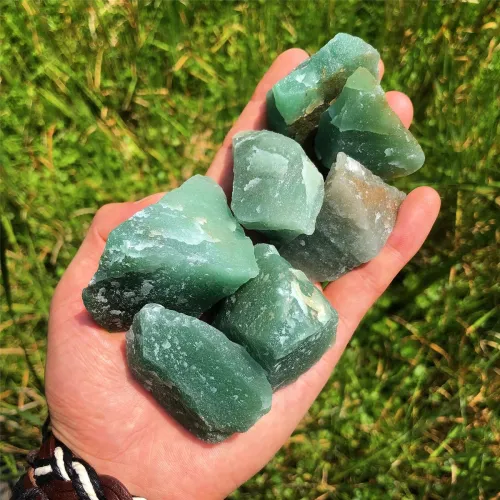
How to spot fake green aventurine without tools?
Focus on weight and warmth - quartz stones maintain coolness longer when clutched. Also inspect under daylight: Genuine pieces usually show varying fleck intensity across different stone zones.
What does natural aventurine reveal under ultraviolet light?
It typically exhibits faint or patchy fluorescence unlike synthetics which may glow strongly green. Note results vary depending on mineral impurities, so combine with other tests.
Which naturally-occurring aventurine color is rarest?
Deep blue hues occur less frequently than greens. However, uniform color saturation across stones warrants caution since genuine material almost always shows some zoning.
Why might faux aventurine chip more easily?
Glass and resin alternatives exhibit lower durability than quartz-based material. Genuine aventurine's hardness allows appropriate jewelry use when properly cut.


$
